Slaughter Day
[What follows is a relatively unfiltered description of our experiences slaughtering 14 Jumbo Cornish Cross hens that we’d raised with the intent of humanely raising and slaughtering chickens for meat. My descriptions of “the act” itself do not provide any detail beyond what is required to convey the actions we took. The accompanying images are really no more graphic than you’d see at a neighborhood butcher’s shop with a few exceptions: Americans aren’t accustomed to seeing their food with the head and feet still attached.
Consider that this is a very humane version of what occurs with the prep of the meat you eat. I encourage you to read on and contemplate the choices you make with your food.]
A dull ache in every vertebrae of my back, my calves are burning, and I can't move my neck. We're standing over the cutting board, on opposite sides of the kitchen counter pulling off crispy bits of skin, white and dark meat, and shoveling it into our mouths. Just a bit of butter, salt and pepper at 350 in the convection oven and it tastes like this? This is amazing. Ouch, my neck.
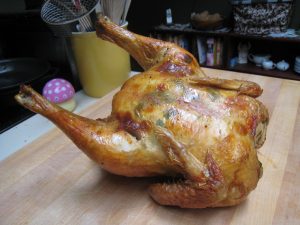
An hour before, we were in the front yard off the edge of the driveway gutting this same bird. There's no way I thought I'd bring myself to eat it today. Following the visceral, bloody, and somewhat disturbing experience, I was left with passable knowledge of chicken anatomy and a freezer full of vacuum sealed whole birds, halves, quarters, parts, and offal. Over the course of two days we slaughtered 14 Jumbo Cornish Cross chickens. Some parts of the process are pretty nasty and I was pretty sure I'd spoiled my appetite for poultry for the foreseeable future. But here I was... eating the chicken I'd just killed... and it was easily one of the tastiest things I'd eaten in a long time.
Having slaughtered a rooster, last year, we changed our approach. We learned a lot in the slaughter of Bucket. I quite simply hacked off his head with a big sharp chefs' knife coming down on a stump. The results were pretty messy, as the involuntary flapping made it tough to hang onto him. The scalding water was too hot and had actually started to cook the meat. We devised a plan, learning from experiences and a fair amount of reading. We were ready.
Slaughter day. We woke up early and started the prep. Big Rubbermaid tubs, a folding table (our kitchen from Burning Man), a large propane burner and 30 quart stock pot, ice, some really sharp knives, cutting boards, Latex gloves, 5 gallon buckets, 1 gallon Ziploc bags, and some trash bags. After working through some kinks (cone too big, angle of cutting boards wrong, broken thermometer, water too hot, water too cold, need some chairs, better knife needed for this or the other, ran out of propane on this tank, need another bucket, etc.), the next two days followed the same pattern, one or two birds at a time.

I built a small cone out of some galvanized roof flashing and a couple small bolts. The cone was affixed to the tree, with a 5-gallon bucket hanging below it. At first catching one bird at a time was easy, there were 14 of them and they were, I think I mentioned this once or twice, lazy and fat. I entered their little pasture, walked up and grabbed one. Walking back, I'd put it upside down through the cone, holding the feet, wait for the bird to calm down (the cone seemed to have this effect on them), and with the sharpest knife we own, cut through the jugular vein on the side of the neck. The blood would run down into the bucket suspended below, and half a minute later, the bird would pass out. This method is similar to the slaughter outlined in the Koran in preparation of "halal" meats.
While there is very little literature on humane slaughter of fowl, I endeavor to end the lives of any animals I kill in the most humane way possible. I've had a few muted debates with friends about the concept of "humane slaughter" and, while I agree the phrase is material enough for several comedy routines, it captures what I'm trying to do. Why raise an animal in a humane way, only to end its life in fear? Dr. Temple Grandin is an expert on humane slaughter of livestock and, while most of her work is geared toward large mammals, I found much of her writing useful. She's published some simple guidelines, many of which seem like common sense (keep herd animals together as long as possible, don't let them witness the slaughter of another, etc.), but are useful when considering what we're doing and why. The method we chose for slaughter is condoned, by her, for most animals. She's a really interesting person and I highly recommend looking her up, even if you're only marginally interested in slaughter; she's written books on autism and has a very unique first-person perspective on the topic.
After the bird fell unconscious, I'd tighten my grip on its feet. "Death throws" are involuntary muscle spasms that cause the bird to flail about (the source of the phrase "like a chicken with its head cut off") for 15-20 seconds. The cone contained the wings and held them against the body, which made this easier. The bird was dead, now.
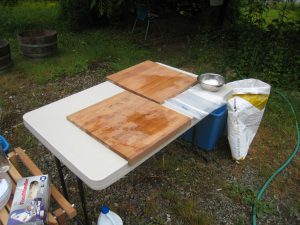
We'd laid out our workspace in such a way as to let us progress with each of the bird through "stations," each with a separate purpose. While I have the strong urge to define the process with a flow chart, swim lane diagrams, input and output charts, and SLAs, it's pretty simple:
- Dead chicken goes into 140° Fahrenheit water and sits for 30 seconds. This loosens the feathers for plucking.
- Hot wet smelly chicken (smells like a wet feather pillow covered in chicken poop) goes into Rubbermaid tub filled with ice water. This keeps the chicken from cooking and helps to loosen the feathers. We occasionally had 3 or 4 floating around in the ice bath, gruesome looking.
- Pull a wet cold chicken out of cold water tub and starts plucking into a second Rubbermaid tub. This is much harder than it seems like it should be and my ex was much better at it than I.
- When the majority of the feathers were off, the chicken would be moved to the first of two cutting boards. Pinfeathers and as much stubble as can be pulled off is; wingtips are a particular bitch.
- On the same cutting board, I'd cut off the head (sharp knife, lots of pressure) and the feet. I got good at taking off the feet, at the knees, using a sharp knife I'd pop the tendons and separate the cartilage.
- Feet get the 'skin' and 'toenails' pulled off. The feet are a great reminder of the animals' prehistoric roots... more reptilian than bird.
- Feet go into a bag for stock.
- Bird moves to second cutting board. At this point, it looks almost like the chicken you would buy in a store.
- Gutting the bird takes a little bit of time, though I got much faster by the end of the second day. In short, I start at the top, free the "top organs" and then do the other end.
- The trachea and esophagus can be pretty easily freed from the spinal column with hands. On day one, we didn't feed the birds, and the crop was small and easily freed. The "crop" is a small sack that contains all the food the chicken has recently eaten. Think of it as a squirrel's cheek pouch, it allows the chicken to take in more than the digestive system can handle. Day two, we fed them and the crop was huge and messy. Did I mention that these chickens really ate a lot?
- I would hang the legs of the bird off the table, over a 5 gallon bucket, cut a circle (or modified square, usually) around the "vent" (aka. butt), grab around the vent and pull. Put bluntly, this is nasty. I was basically pulling the entire digestive system of a chicken out, through its butt. It smells pretty strongly. I can't describe the smell, other than to say it smells like chicken guts.
- There's a lot of cleanup on the bird that occurs at this point, too. I pack the livers, gizzards, and hearts into an "offal" bag. I hope to make some pate or a terrine; I tried each of these fried, that weekend, and couldn't stomach it. The smell was... too familiar. Discarding the rest, including lots of little bits that took time to get out (lungs, for instance).
- What's left is exactly what you'd get if you bought a whole chicken at the store. The only notable difference is that the neck has a little extra skin left on it. We either froze them like this or broke it down further to breasts, thighs, wings, etc.